
Services as Software (SaS) is no longer a future prediction; it’s already reshaping industries in real time. From consulting to customer service, certain service types are being re-coded into platforms, delivered at scale without the need for traditional human-led execution.
The question isn’t if it will impact your business; it’s when and how much. The quiet revolution of “platformization” is happening beneath the surface, and the winners will be those who spot which services are next in line for automation.
What Makes a Service “SaS-Replaceable”?
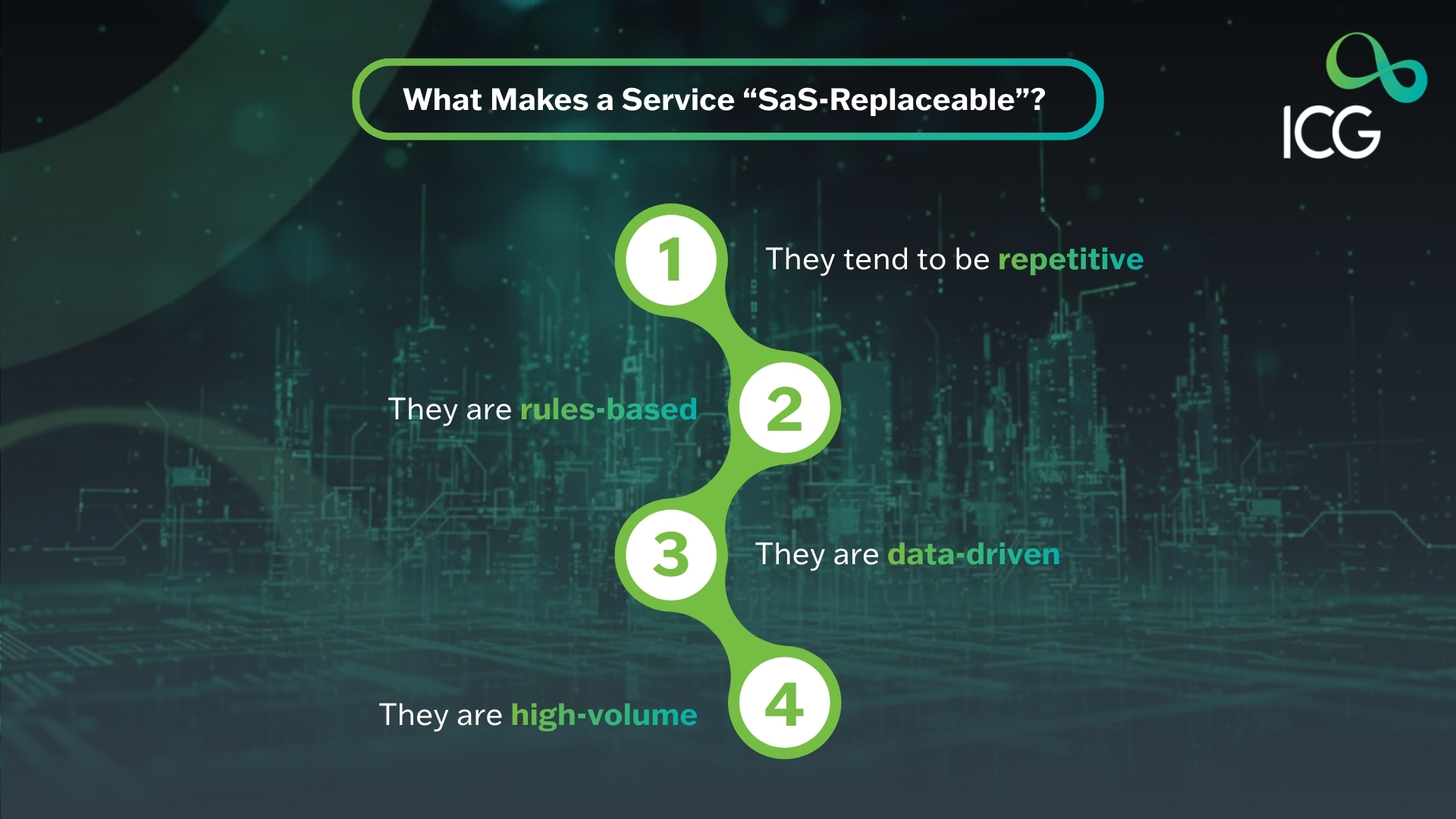
Not every service is equally at risk of being replaced by the Services as Software (SaS) model. The ones most vulnerable share a common set of traits that make them easy to translate into code and run at scale without human intervention.
First, they tend to be repetitive, the kind of tasks that follow the same sequence of actions every single time, with little to no variation. Think of processing refund requests, generating monthly invoices, or verifying identity documents. Once these steps are defined, they can be replicated endlessly by software without fatigue or errors.
Second, they are rules-based. These are services with clear inputs, well-defined logic, and predictable outputs that leave little room for subjective judgment. For example, approving a loan based on a fixed set of eligibility criteria or scheduling appointments within preset availability rules. The more rigid the rules, the easier it is for a platform to execute flawlessly.
Third, they are data-driven. Services that rely primarily on structured, measurable, and quantifiable data rather than unstructured information or abstract reasoning are particularly susceptible. Real-time analytics, compliance checks, or performance tracking can all be performed more quickly and accurately by a system designed to process data streams at high speed.
Finally, they are high-volume. These are tasks or services that must be delivered repeatedly and at scale, where speed and throughput are more valuable than deep personal engagement. Managing thousands of customer queries a day or monitoring millions of transactions for anomalies are prime examples.
When human creativity, emotional intelligence, or nuanced decision-making is not central to the value being provided, and when the entire process can be standardized end-to-end, SaS platforms often outperform people. They deliver with greater consistency, lower costs, and the ability to scale instantly , making them an irresistible choice for businesses seeking efficiency and market advantage.
Top 5 Service Functions Most at Risk
Manual Customer Support → AI Chat Platforms AI chatbots have moved far beyond basic FAQs. They now handle account inquiries, technical troubleshooting, and even payment disputes, all without human escalation. This is eroding the need for large offshore customer service teams.
Research & Reporting → Real-Time Market Intelligence Tools Where analysts once compiled lengthy PDF reports, SaS platforms now provide live dashboards that pull in market data, competitor analysis, and sentiment tracking, updated every second.
Onboarding & Training → Interactive Self-Serve Learning Platforms New employee orientation, product training, and compliance modules are shifting to adaptive learning systems that personalize content based on the learner’s progress, eliminating hours of manual training sessions.
Scheduling & Admin Tasks → SaS Calendar and Workflow Automation AI-driven scheduling, contract routing, and expense approvals are cutting down on back-office headcount. These platforms not only automate workflows but also optimize them for speed and compliance.
Basic Consulting or Audits → Platform-Delivered Diagnostics From SEO audits to financial health checks, many “entry-level” consulting services are now being delivered as automated assessments. These tools simulate the diagnostic process of experts and recommend best practices instantly.
What Businesses Should Do Now
The SaS shift doesn’t have to be a threat; it can become a powerful competitive edge. The first step is to map out vulnerable functions by identifying internal processes or external service offerings that are repetitive, rules-based, and ripe for platformization. Once you know where the opportunities lie, move quickly to build or integrate SaS models, rather than waiting for a competitor’s tool to replace your service. This could mean adopting existing solutions to boost efficiency or developing proprietary platforms that set you apart. The fastest adopters won’t just cut costs, they’ll unlock the ability to expand reach, deliver with greater consistency, and scale at a pace human-dependent operations simply can’t match.
SaS Doesn’t Replace People, It Frees Them
The goal of SaS isn’t to eliminate human intelligence; it’s to remove friction. When repetitive execution is handled by software, your team can focus on high-value work, innovation, relationship-building, and strategy. The winners of this shift will be those who retrain and redeploy human capital toward areas where technology can’t yet compete: creative problem-solving, complex negotiations, and emotional intelligence.
Conclusion
We’re at a tipping point. In the coming years, the service economy will be rebuilt as software. Those who recognize the signs and embrace SaS will lead with speed, consistency, and scale. Those who don’t will find themselves competing against platforms that never sleep, never forget, and get better with every data point. The SaS era isn’t coming; it’s here. The only question is whether you’ll be the one rewriting the rules or the one trying to keep up.
The ICG Approach
At ICG, we offer a customized approach that empowers your teams with the latest insights and technology expertise to navigate the demands of today’s digital age. As Saudi Arabia embarks on its digital transformation journey, ICG plays a pivotal role in shaping the Kingdom’s tech landscape by providing cutting-edge solutions, strategic consultancy, and fostering innovation. Our comprehensive guidance, from fundamental concepts to practical implementation, helps organizations mitigate risks, stay ahead of the competition, and unlock their full potential in the accelerating digital environment.
Ready to talk?
Request your free Consultation to learn more about ICG’s capabilities and enablement to embark on a transformative expedition toward the summit of success.