For years, AI-powered dashboards, analytics platforms, and predictive models have quietly assisted businesses in clarifying complexities. These guided leaders toward smarter decisions. This wave of Digital AI delivered real value: clearer insight, faster analysis, and measurable efficiency gains.
However, it also had a clear limitation. In practice, AI could give advice, but humans still need to take action. Now, that line is fading. As a result of this. Enterprises are entering a new phase where AI doesn’t just inform decisions but executes them in the physical world. This shift, often described as Physical AI, represents a fundamental redesign of how intelligence operates inside organizations. Consequently, in fast-moving, high-pressure environments, it’s becoming less of an option and more of a necessity.
The Transition of AI’s Function from Insights to Action
In the past, digital AI has been secondary. Humans examined the information, pointed out discrepancies, and made recommendations. They had complete control over execution, whether it was modifying production schedules, fixing operational problems, or reallocating resources. That dynamic has been altered by physical AI.
AI systems may now function independently within predetermined bounds rather than waiting for human involvement. They are able to coordinate movement across intricate systems, reroute logistics when conditions change, and adjust machinery in real time. Intelligence shifts from dashboards to the real places where work is done.
This shift is particularly significant in today’s fast-paced business environment, where delays carry a high cost. The UAE is projected to invest $31 billion in the logistics sector by 2026, highlighting the growing focus on the GCC region. Meanwhile, Saudi Arabia is signaling its ambitions to become a global commercial hub through initiatives such as the Red Sea Global Port and a $267 billion investment in the industry.
Looking ahead, we must embrace a future where agility and innovation are paramount. The integration of artificial intelligence, automation, and data analytics will redefine operational Physical AI allows organizations to respond at machine speed while still preserving oversight and accountability.
What Makes Physical AI Fundamentally Different
The gap between digital and physical AI is structural rather than gradual. Execution is supported by digital AI. It is carried out via physical AI. The rules shift once AI is in charge of real-world operations. Decisions must frequently be made in milliseconds. Systems must function safely in the presence of humans, machinery, and infrastructure. Reliability becomes essential to the objective rather than just a nice-to-have.
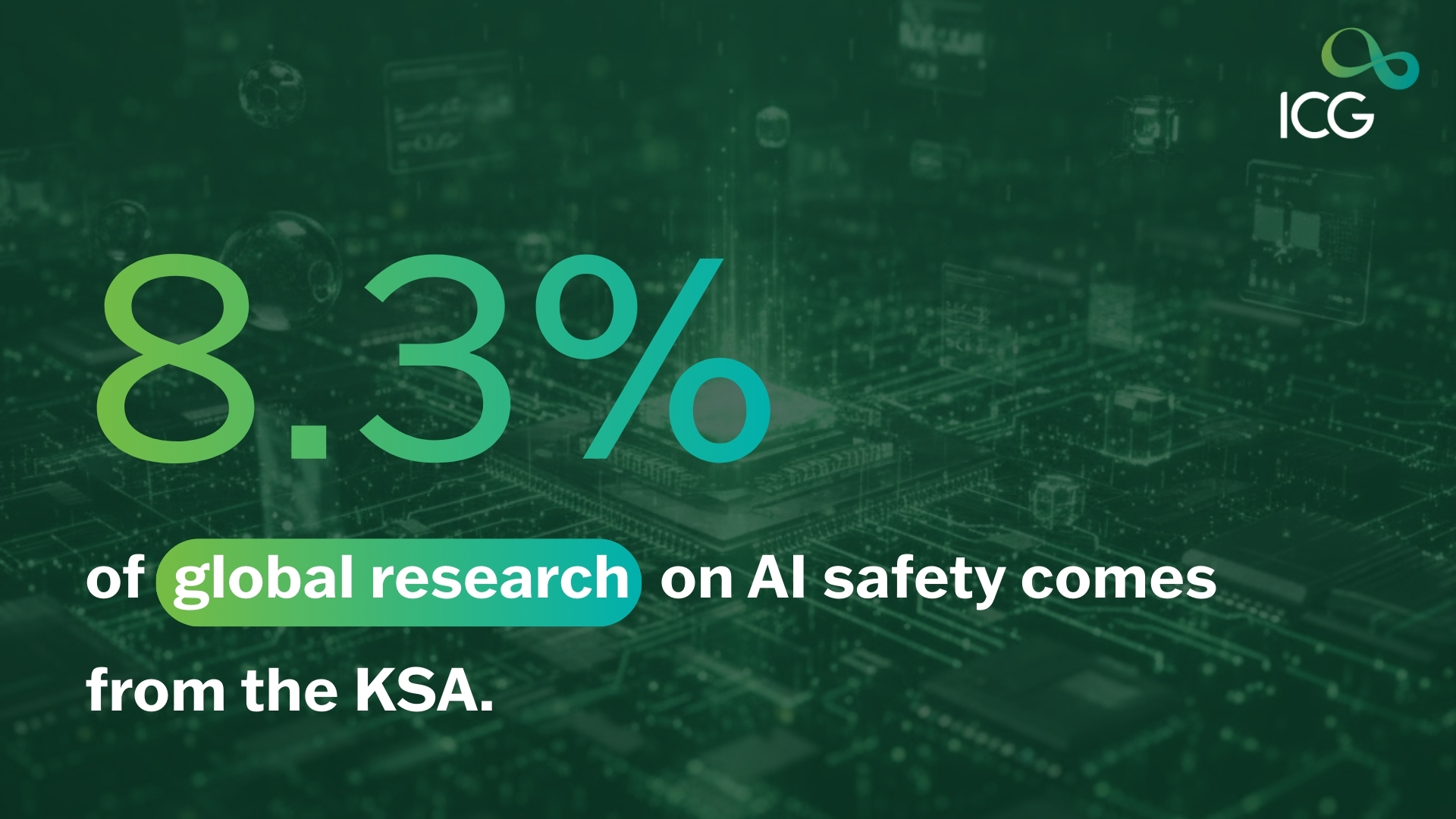
These restrictions call for a reevaluation of AI design and governance. Instead of being brittle, models should be robust. When something goes wrong, systems must also collapse safely rather than catastrophically. Saudi Arabia demonstrated its leadership in responsible AI by ranking first in the region and eleventh globally in the Global Index on AI Safety. 8.3% of global research on AI safety comes from the Kingdom.
Physical AI thus forces businesses to reconsider risk, validity, and accountability. The crucial question is no longer accuracy alone. What counts is whether a system can be trusted over time, under strain, and while in motion.
The Intelligence Behind Physical AI
Physical AI is fundamentally an ongoing process: sense, decide, act. First, real-time data streams that record physical signals such as movement, position, temperature, or visual context, as well as computer vision and Internet of Things sensors, power sensing. They consequently provide situational awareness that is more akin to human perception.
Further, complex AI models and reinforcement learning methods that compare possibilities to objectives and limitations are used in decision-making. Unlike static, rule-based systems, these models evolve in changing surroundings by learning from past mistakes.
Action is carried out through machines, control systems, or automated workflows that directly affect the physical world. To meet strict latency and reliability requirements, much of this intelligence runs at the edge, close to where data is generated, rather than in distant centralized systems. What defines Physical AI isn’t a single technology. It’s the seamless integration of perception, intelligence, and execution into a system that continuously adapts.
Adoption of AI in Saudi Arabia and the UAE is anticipated to pick up speed by 2026 on three fronts:
- As data readiness improves, government deployment is expected to increase quickly, decreasing manual tasks by up to 30%.
- Due to language and cultural demands, it is anticipated that Arabic-optimized agents for activities such as information retrieval, email editing, and translation would become increasingly common.
- AI tailored to the energy, financial, and healthcare industries is expected to enter the market rapidly, spurring innovation in the region’s major economic sectors.
Why Enterprises Are Paying Attention Now
More organizations are treating Physical AI as a strategic capability, not an experiment. As a result, when systems constantly optimize rather than waiting for planned reviews or human intervention, operational efficiency increases. Physical AI enhances asset use in complicated situations, minimizes waste, and smooths variability.
Speed and adaptability matter just as much. When it comes to practice, physical AI systems respond instantly to unexpected changes, adjusting production parameters, rerouting shipments, or detecting early signs of equipment failure.
Beyond that, risk reduction is another major driver. By monitoring physical systems in real time and acting proactively, Physical AI helps prevent downtime, safety incidents, and cascading failures. This shift from reactive problem-solving to autonomous prevention is especially valuable in capital-intensive and mission-critical industries.
For many enterprises, this marks a transition away from isolated pilots toward embedded capability, where intelligence becomes part of the operating fabric, not an external tool.
Laying the Groundwork for Physical AI
Implementing a single system is not the goal of adopting physical AI. Strategy, governance, data, and technology must all be in line with an AI-first basis.
The first step is AI transformation. Instead of bolting AI onto outdated workflows, organizations must restructure processes and decision models to accommodate autonomous systems collaborating with people. Because they enable teams to test and recreate physical systems in virtual environments, digital twins are essential. This enables safe training, stress testing, and validation of AI behavior prior to deployment.
IoT usage, AI developments, and the need for real-time analytics are driving the GCC AI Digital Twins Market, which is estimated to be worth USD 1.2 billion. Digital twins are being used by important industries like manufacturing, healthcare, and transportation to increase productivity and predictive maintenance.
Trusted data and analytics foundations are equally essential. Physical AI is only as reliable as the data feeding it. Without accurate, timely pipelines, even the most advanced models fall short. Finally, robust enterprise and cloud foundations, including edge computing, provide the scalability and resilience required for real-time, distributed autonomous operations.
Conclusion
The shift from Digital AI to Physical AI represents a fundamental change in how enterprises apply intelligence. AI is no longer limited to insight and recommendation. It is becoming an active participant in execution. Organizations that rethink how AI works today, how it’s designed, governed, and embedded into operations, will be far better positioned to operate with speed, resilience, and autonomy in the physical world ahead.
The ICG Approach
At ICG, we offer a customized approach that empowers your teams with the latest insights and technology expertise to navigate the demands of today’s digital age. As Saudi Arabia embarks on its digital transformation journey, ICG plays a pivotal role in shaping the Kingdom’s tech landscape by providing cutting-edge solutions, strategic consultancy, and fostering innovation. Our comprehensive guidance, from fundamental concepts to practical implementation, helps organizations mitigate risks, stay ahead of the competition, and unlock their full potential in the accelerating digital environment.
Ready to talk?
Request your free Consultation to learn more about ICG’s capabilities and enablement to embark on a transformative expedition toward the summit of success.