The Leadership Crisis No One Is Talking About
Leadership models haven’t kept up with the world they’re supposed to guide.
Most leadership programs still teach frameworks from the 1990s hierarchy, delegation, “vision statements,” and long-term planning exercises designed for predictable markets. But today’s leaders don’t operate in predictable markets. They lead in environments where AI tools change weekly, competition emerges overnight, and workforces span continents, cultures, and now algorithms.
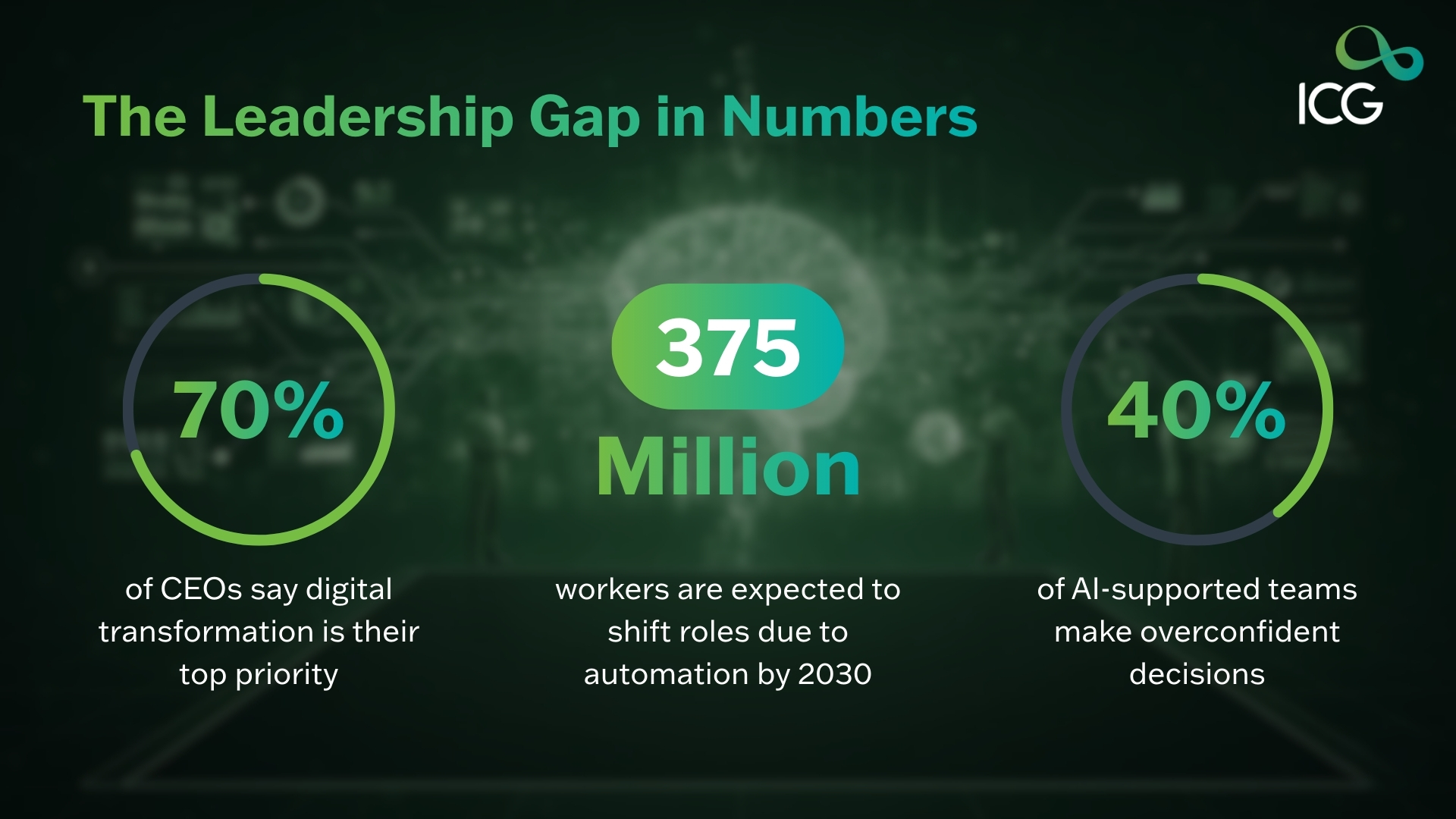
70% of CEOs cite digital transformation as their top priority, yet only 20% of leadership programs include AI or data training. Even more alarming, the World Economic Forum predicts that 375 million workers will shift roles due to automation by 2030, but few executives are being trained to lead through that shift.
We are heading toward 2030 with leaders prepared for yesterday.
What Will Define Leaders in 2030
Contrary to popular belief, the future leader is not the most technical person in the room. They are the one who understands how humans and intelligent systems work together.
Three defining traits will separate tomorrow’s leaders from today’s managers:
1. Digital Fluency and AI Literacy
Leaders don’t need to code, but they must understand how data flows, how AI makes decisions, and how to audit algorithmic bias. They should be able to ask: Why did the AI pick this? What are the ethical implications? Can I override it?
A 2024 MIT study revealed that teams using AI without leadership guardrails made overconfident decisions 40% of the time. Technology without wisdom is risk and wisdom without technology is irrelevance.
2. Human Skills — Now More Critical Than Ever
Ironically, the rise of AI is increasing the demand for humanity in leadership. Employees don’t follow titles anymore, they follow people who listen, adapt, and care. Empathy, resilience, and the ability to stay calm when the system breaks will be as valuable as technical intelligence.
Microsoft CEO Satya Nadella once said his biggest advantage wasn’t strategy it was empathy. Under his leadership, Microsoft didn’t just pivot technologically; it re-centered its culture around emotional intelligence and tripled its market value.
3. Ability to Lead Hybrid Human–AI Teams
Soon, some teams won’t just include designers, analysts, and developers, they will include AI agents. Leaders will have to manage workflows where algorithms generate ideas, humans critique them, and both improve together.
Why the Old Curriculum Fails?
Most leadership training still looks like motivational retreats and case studies from companies that no longer exist. They focus on theory, not execution. PowerPoints instead of prototypes. Strategy documents instead of simulations.
A study found that only 31% of leadership trainees feel “prepared” after attending corporate programs, and half revert to old habits within 45 days. The problem isn’t intelligence, it’s irrelevance. These programs train leaders for certainty, when today’s leaders need to master ambiguity.
The Blueprint for the New Leadership Curriculum
It’s time to rebuild the leadership curriculum from the ground up. Not with more modules but with new mechanics. Here’s what the future of leadership training must include:
1. AI-Integrated Decision Labs
Instead of theoretical case studies, leaders should train using AI-powered business simulations. Tools like ChatGPT, Midjourney, or real company data can be used to simulate pricing decisions, crisis response, or marketing strategy, and trainees can watch in real-time how AI influences outcomes.
2. Data Judgment and Ethical Foresight
AI can optimize but leaders must decide what to optimize for. Future-ready leaders should be trained in bias detection, data ethics, and risk modeling, not just dashboards and KPIs.
3. Project-Based Learning Over Classroom Lectures
Leadership cannot be taught through keynote speeches. It must be absorbed through iteration, experimentation, and failure. Startups have proven that MVPs teach faster than manuals and leadership should be treated the same way.
4. Continuous, Lifelong Learning: Not One-Off Certificates
Leadership is no longer a status achieved it’s a skill updated. The leaders of 2030 will not attend programs, they will subscribe to upgrade systems; therefore, organizations should adapt learning platforms, AI-personalized coaching, and peer-based decision boards.
Conclusion
We cannot wait until 2029 to prepare leaders for 2030.
This is not just an educational reform, it is a strategic survival move. The organizations that redesign their leadership pipelines now embedding AI literacy, emotional depth, and rapid learning cycles, will be the ones shaping industries, not reacting to them.
Leadership is no longer about having answers. In 2030, great leaders will be defined by their ability to ask better questions to both humans and machines.
The ICG Approach
At ICG, we offer a customized approach that empowers your teams with the latest insights and technology expertise to navigate the demands of today’s digital age. As Saudi Arabia embarks on its digital transformation journey, ICG plays a pivotal role in shaping the Kingdom’s tech landscape by providing cutting-edge solutions, strategic consultancy, and fostering innovation. Our comprehensive guidance, from fundamental concepts to practical implementation, helps organizations mitigate risks, stay ahead of the competition, and unlock their full potential in the accelerating digital environment.
Ready to talk?
Request your free Consultation to learn more about ICG’s capabilities and enablement to embark on a transformative expedition toward the summit of success.